



Marketing teams deal with a lot of data every day. Traffic reports, sales numbers, ad results, customer behavior, and product performance all come from different tools. When all of this information is scattered, it becomes difficult to find out what strategies are working and where they need to concentrate.
If you run an e-commerce business in 2026, you might have felt the overwhelm that comes from managing too much marketing data. According to a survey by Loopexdigital, 42% of B2B marketers say that their biggest hurdle to lead generation is a lack of quality data.
This overload slows decision-making. You spend more time checking dashboards than improving campaigns. And in ecommerce, small delays can affect revenue, especially when trends change fast.
In this guide, we will show you effective and practical ways to make complex marketing data easier to read. We will look at selecting the right metrics, creating clean dashboards, reducing reporting noise, and using quick checks to avoid making poor decisions. Let’s get into it.
What is Marketing Data?
Marketing data is any information businesses collect about customers, markets, and campaigns to understand behavior, personalize messages, optimize strategies, and ultimately drive growth and ROI.
It tells you who your customers are, where they come from, what they click, and what finally makes them buy. Every activity you do in ecommerce, like ads, emails, product listings, and website updates, creates data that can guide your next steps.
Key Types of Marketing Data
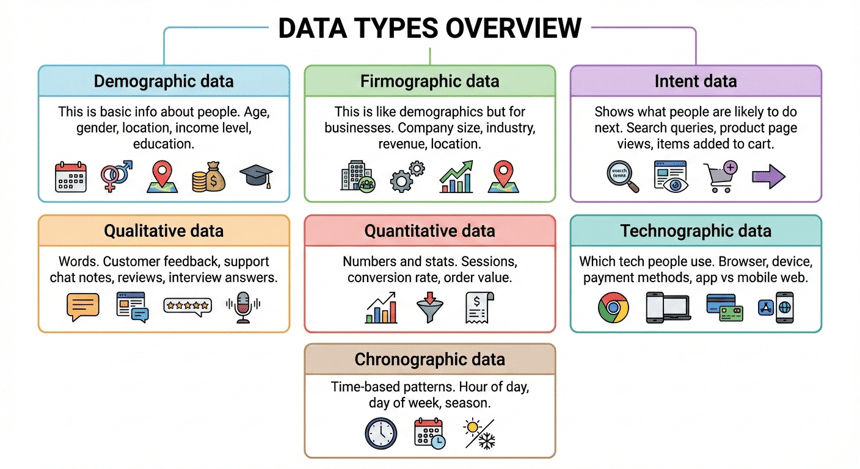
- Demographic data: This is basic info about people. Age, gender, location, income level, and education all come here. For ecommerce, it helps you target ads and choose product styles. You use it to decide who sees a campaign.
- Firmographic data: This is like demographics, but it applies to businesses. For example, it includes data about company size, industry, revenue, and location. Useful for B2B sellers or marketplace vendors who sell to shops or resellers.
- Intent data: It shows what people are likely to do next. It includes search queries, product page views, items added to cart, etc. If someone looks at a product repeatedly, that signals buying intent. You can use this to target follow-ups.
- Qualitative data: This data comprises words. It may include customer feedback, support chat notes, reviews, and interview answers. It explains the “why” behind behavior. Read these to understand user problems.
- Quantitative data: It comprises numbers and stats. For instance, sessions, conversion rate, and order value are all quantitative data. These give you measurable trends and let you compare changes over time.
- Technographic data: This data is used by tech people. It may include browser, device, payment methods, and app vs. mobile web. This matters for checkout design and ad placement.
- Chronographic data: This data is a set of chronological patterns. It measures a specific time duration, like hour of day, day of week, or a season. It shows information about when customers buy or when ads perform best.
Collection of Marketing Data
The marketing data is collected through the tools you may already use. For example, Google Analytics, Facebook Ads Manager, TikTok Ads, email platforms, CRM tools, heatmap tools, and your e-commerce platform.
Each tool generates numbers and insights according to its working. And here the real complexity begins. When the same customer appears across multiple platforms, you get duplicate information, mismatched reports, and different versions of the same result.
That’s why a lot of teams find it difficult to sort the marketing data when they see scattered numbers and information across different dashboards.
The Significance of Marketing Data in Making Decisions for Businesses
Marketing data plays a big role when decisions are related to money, time, and growth. In ecommerce, every small change affects sales. So, marketing data helps you see what is actually happening instead of what you think is happening. According to Marketing Evolution, 76% of the leaders make decisions based on data analysis.
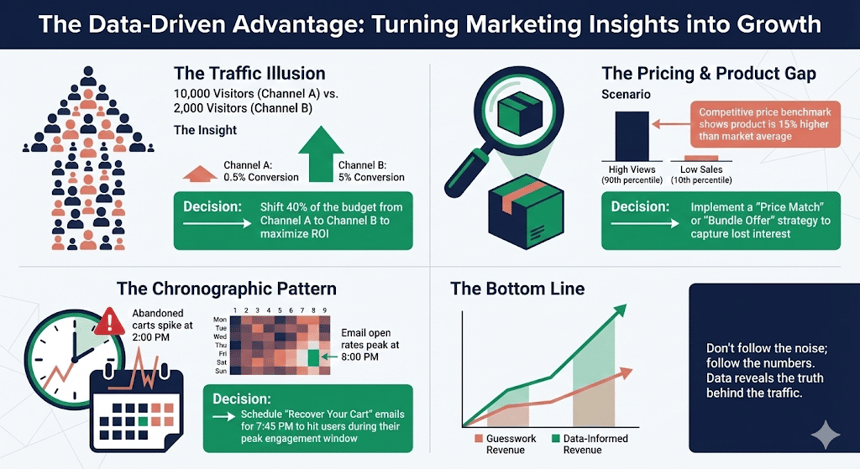
For example, if the traffic is increasing, it does not always mean growth. Marketing data helps you connect traffic with conversions, revenue, and customer quality. You may find that one channel brings fewer visitors but higher order value. Without data, that insight is missed, and budgets go in the wrong direction.
Marketing data also helps a lot in product choosing and pricing decisions. For example, if a product is getting views but not sales, maybe its price is higher than your competitors in the market. Or, one of your products is getting fewer sales but generating more revenue than the others, but you do not focus on that particular product. If you have all the data about these things in hand, you can make better decisions.
Another role of marketing data is timing. Chronographic patterns show when users buy, when carts are abandoned, and when emails get responses. This helps decide when to run campaigns or launch offers.
Smart Ways to Simplify Complex Marketing Data
When marketing data becomes confusing, it is usually because there is too much information coming from too many sources. So, simplifying this data and arranging it in a clear way will help a lot when making decisions.
Clean and Group Marketing Data into Simple Categories
One common problem is that reports stay scattered. Website data is present in one tool. Ad data comes from another. Sales numbers come from the store dashboard. When you check all of them separately, nothing connects. This is where grouping helps.
Start by placing related numbers together. Keep traffic data in one place so you can see where visitors are coming from. Keep conversion data together so you know what actions people are taking. Revenue should stay separate so it does not get mixed with clicks or views. Costs should be tracked clearly so spending is always visible.
Once the data is cleaned and placed into relevant categories, it will be quite easy to read and analyze. You stop jumping between tools and start seeing clear patterns that support better decisions.
Turn Raw Marketing Numbers into Clear Visual Views
Raw numbers are difficult to understand when they are in tables or long reports. You look at rows of data and still feel unsure about what is actually happening. This is where simple visuals make a real difference. The patterns in the number data become easy to understand when it is shown in charts or dashboards.
For instance, a line chart showing weekly revenue tells you more than a spreadsheet with hundreds of rows. Segment views also help. When you separate new customers from returning ones, you start seeing how different groups behave. Visual dashboards also save time for teams, especially when you use pre-built Looker Studio templates designed for various data sources and reporting purposes. Instead of explaining numbers again and again, everyone looks at the same view and understands the situation.
There are plenty of online tools available in the market that can convert numerical data into charts and dashboards. For example, Power BI is a good tool that can convert your data into visuals with advanced data analysis capabilities. After converting numbers into visuals, it will be quite easy for the decision makers to analyse the data and make decisions accordingly.
Focus on KPIs That Actually Push Growth
Many teams track too many numbers because every tool shows something different. One dashboard shows clicks. Another shows impressions. A third shows engagement. When you put all of them together, the data becomes lengthy and difficult to process. You know what happened, but you do not know what to do next.
In e-commerce, growth decisions usually depend on a few key things. So, you need to consider important key performance indicators. Some of these indicators include return on investment (ROI), customer lifetime value (CLV), customer acquisition cost (CAC), click-through rate (CTR), cart abandonment, etc.
The ROI tells you how much money you invested for a specific purpose and how much revenue it generated. The CAC tells you about the average cost to bring one customer in. The CTR is the ratio of people clicking on your ad or link to the total number of people who actually saw it.
Conversion rate is another important indicator. Traffic can increase, but if users are not buying, something is broken. Engagement helps explain this. If people are not clicking, scrolling, or interacting, they are not interested. Cart abandonment means a customer added a product to the cart but left the website without completing the purchasing process. It helps in analyzing checkout issues or user experience problems.
When teams focus on these few KPIs, decisions become easier. You stop debating small metrics and start fixing real problems. That is how data supports growth.
Summarize Long Reports Into Clear Takeaways
In ecommerce, reports often get very long due to the collection of data from multiple sources. A weekly marketing report can easily turn into five or six pages. You may have traffic data, ad performance, email stats, product movement, and notes from the support team in one report. Reading all of it every time is not possible. And when you need to make quick decisions, it becomes more difficult to follow long reports.
Moreover, not every type of data needs deep analysis. Performance summaries, campaign results, customer feedback, and internal updates are the best candidates for summarization. For example, after a paid ads campaign ends, you do not need every click and impression. You need to know what worked, what did not, and what should be changed next.
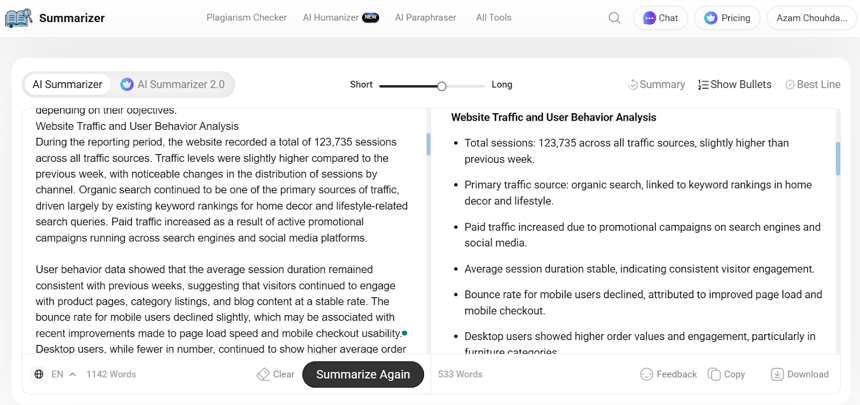
The summarization process can be made easier with AI Summarizer. This tool can summarize text effectively by extracting the important data and making a brief summary. Also, it provides bullet point summaries. For example, look at the following screenshot that demonstrates how it extracts the main points and presents them in a concise bullet format:
Automate Reporting to Keep Data Consistent
When reports are created manually, there are high chances of errors. Numbers can be copied incorrectly, or the dates may get mixed up.
Automating the reporting workflow helps fix this. Automated dashboards pull data directly from your tools and update on their own. You do not need to refresh files or paste numbers every day. Instead, new data automatically comes up there.
Daily snapshots are also useful, especially for ecommerce businesses. Sales, traffic, and ad spend can change quickly. A daily view helps you notice sudden drops or spikes before they turn into bigger issues. Instead of checking everything manually, you rely on the system to keep track.
Predictive alerts add another layer of support. When the conversion rate drops below a set level or ad costs rise unexpectedly, alerts notify the team. This allows quick action without constant monitoring.
Automation also reduces human error. When the process runs on its own, reports stay consistent. Teams spend less time preparing data and more time making decisions based on it.
Wrapping it Up
The modern marketing strategies have made data complex and difficult to process. For a marketing team running paid ad campaigns on multiple platforms like Meta, TikTok, Google, etc., it becomes tough to keep track of each campaign and extract useful insights from this data. Also, there are too many performance indicators to check for sales and growth.
So, if a business tries to grasp each and every little detail, without knowing what actually matters and what can be ignored, it will become difficult for its marketing teams to process data. Ultimately, they will fail to make informed decisions using scattered numbers and looking at multiple reports for the same KPI.
Some of the best ways to organize and simplify this kind of complex marketing data are discussed in this blog. By focusing on key metrics, grouping related data, and using simple summaries, marketing teams can see problems early and fix them before they affect revenue. Campaign adjustments happen on time, budgets are spent more carefully, and customer behavior becomes easier to understand.
You do not need more data. You need better clarity. When marketing data is organized and easy to read, it supports smarter decisions and steady growth without unnecessary effort.